
Extensionitis and the Problem with Hospital Transfers
The frustrating difficulty of hospital admissions and transfers.

“Ate Ella, do you still work in PGH?”
The message is from a high school friend. We worked in the student government, but I haven’t spoken to her in years. I don’t know what she’s been up to, but she apparently knows I’m a doctor who trained in PGH. At the time of her message, I had, in fact, already graduated from fellowship training and was technically no longer an employee. I tell her so, but knowing there’s always a follow-up to questions like this, I reply, “Why? What’s up?”
My high school friend—let’s call her Twinnie—tells me about how her friend got in a motorcycle accident. During my internship rotation in Trauma Surgery, I learned that in vehicular accidents, we identify the involved: motorcycle versus pedestrian, car versus truck, truck versus cement post, as though they were boxers facing off in a ring. In Twinnie’s friend’s case, it was motorcycle versus pavement. They took him to a hospital, where he was found to have a bruised trunk, a broken arm, and a bleed in his brain. He needed an ICU, the doctors said.
Knowing he was in a hospital is good news. That means a team of doctors is already taking care of him. That means he’s being monitored and receiving initial medical management. But then came the catch: “Ate, they can’t afford the ICU here. Could you help us transfer to PGH?”
I’ve heard requests like this before. The requests vary in severity and urgency. Sometimes they ask if I know a good specialist for this or that illness. Sometimes, it’s about logistics: how to schedule a follow-up, how much an MRI costs, which forms to fill out. Sometimes, it’s simply to ask if their symptoms warrant a trip to the ER.
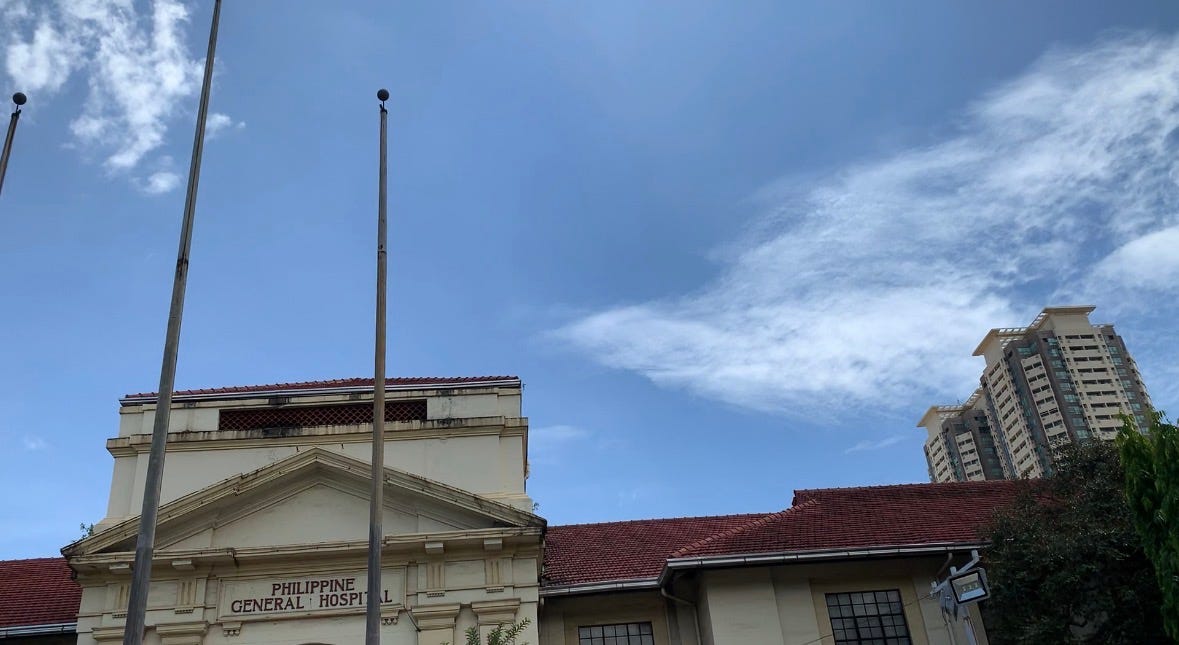
Other times, the questions are like Twinnie’s. Can you get us a room in PGH? Do you know someone in the ER? The Philippine General Hospital, being the national university hospital, is known for its esteemed doctors and services. As a public hospital, the impression is that the services are free. That’s technically true for service or charity patients, but the hospital also has a private arm where patients still pay for hospital rooms, lab tests, and doctors’ fees like in private hospitals. Nevertheless, the public impression stands, patients flock to PGH, and many of my friends and relatives have reached out to ask me to get admitted to PGH.
Patients often feel they need a “kakilala” or a “backer” to get into the hospital system. Among healthcare workers, we call this “extensionitis.” It’s when we, healthcare employees, use our association with the hospital to get family, relatives, friends—the “extensions” of ourselves—into the hospital system. The understanding is that there’s a certain power to being on the inside of a complex system. Truthfully, I can’t say they’re wrong. To be clear, that power isn’t much. A tertiary hospital is a big place with many moving parts and people. Just because I work there doesn’t mean I rub elbows with the medical director, or that they let you in the ER at the mention of my name. But the power isn’t nothing, either. The power lies in knowing who to ask, where to go, and how to navigate the system. The real advantage is the access. Working in healthcare opens the right doors, or at least gives you the right to knock.
It doesn’t feel right, and I often feel guilty giving in to requests like this. I mean, isn’t this like cutting in line at the grocery store? Or a father giving his son a position in his own company? Shouldn’t there be a process to follow? A younger, more self-righteous me would have rolled her eyes at being on the receiving end of a request. People shouldn’t use their connections to get ahead, I used to tell myself.
As with most lessons in empathy, I only understood when I was the one who needed help. In my first year of fellowship training, my grandfather needed admission. My Lolo—my adorable grandfather who loves to sing and eat halo-halo—came down with a bout of pneumonia. His oxygen was dropping, and he wasn’t fully awake anymore. My doctor-brain enumerated everything he needed: oxygen, antibiotics, meds for his heart, probably a feeding tube, too. But my granddaughter-brain just panicked. I messaged Dr. A, a renowned pulmonologist and our previous residency training officer. I am in no way close to Dr. A and am definitely not one to ask him a favor. I’m not even sure he remembers the times I informed him of a referral or when I accompanied him during his rounds. I was always afraid of him. He was strict and intimidating—the kind of person you would never want to see angry. But he was undoubtedly one of the best doctors I knew, and I was desperate. I composed a message as if I were updating him on one of his patients, with a full history, physical examination, and working impression, even offering to call to endorse. I ended with a feeble request that Lolo be admitted under his care.
To my relief, he replied. “Sige, pa-admit na.”
I then spoke with everyone I knew to coordinate the transfer: the triage officer, the ER physician, the residents on duty, my nurse friends from the pay floors, and even the staff from the Pay Admitting section. I knew there was a process to follow. I knew everyone knew what they were doing. I knew I was just another cook spoiling the broth. But I was scared, and with that fear, all knowledge flew out the window.
The same thing happened a few months later, when my uncle needed emergency dialysis, and another time when my aunt needed to be transferred to PGH from a private hospital. Once again, I messaged everyone I knew. I talked to consultants who would admit them, I requested help to find him a room, and I asked the residents-on-duty to check on them. Each time I used whatever social capital I had, a tiny part of myself cowered in embarrassment. I know I couldn’t have done this without the resources I have or the people I know. I know I was using the system in my favor. I realize people like Twinnie don’t actually enjoy messaging out of the blue, knowing they were calling in a favor. A part of them must have been embarrassed, too, unsure how to put their message together, but asking anyway, relying on the off-chance that maybe I could help somehow, anyhow. I know how that feels now.
The part of me that understands constantly wars with the part that knows this isn’t fair. No one should have to depend on connections or friendship cards to access health, a supposedly basic human right. In this country, healthcare expenses are still largely out-of-pocket. Should anyone get sick, the ordinary Filipino pays for everything: doctors’ fees, medicines, lab exams, hospital rooms, and other miscellaneous expenses, including the cotton balls and gauze pads used. A single hospital admission drains all resources. And as if finances weren’t enough of a problem, the system itself is complex and difficult to navigate. What to do? Where to go first? Who to ask? There is no hotline for health-related concerns and no helpline that enumerates how to see a doctor or get admitted. This information mostly comes from relatives, friends, hospital receptionists, and clinic secretaries, and mostly through word-of-mouth. This is not general knowledge that people ought to know straight out of high school.
It makes me wonder, what if Twinnie didn’t know anyone in the medical field? What about the many others who are basically foreigners in hospitals and clinics? As a resident-in-training, I used to receive calls from relatives inquiring about transferring to PGH. One of the most frustrating questions to ask is, “May kilala po ba kayong doktor dito para ma-admit kayo?” Do you know a doctor who can admit you here? Every patient needs an admitting physician, a primary physician to coordinate care, but I’ve always found this question bizarre. Is everyone just expected to know a doctor? The same way they would have a go-to mechanic or masseuse? Thankfully, there’s often a list to follow for those who don’t know anyone, but it’s still frustrating that knowing someone from the get-go is the preferred and more convenient route.
So for Twinnie, I tell her I know someone in the neurosurgery division. Texting someone you know with a favor in mind is an awkward spot to be in, yet another embarrassing use of social capital. I find my colleague’s name anyway and type, “Hi, D! Sorry, favor. Do you think you could help us transfer a friend to PGH?” I omit the part that the patient is actually a friend’s friend, and that all I knew was the patient’s name, age, and the accident he got into. I don’t know his medical history or if there’s a history of stroke or cancer in the family. Luckily, D doesn’t ask. Instead, she gives me action points and options to relay to Twinnie. I communicate with both D and Twinnie for a while before we formulate a plan: transfer to PGH, admit to a private room, choose a consultant (someone D recommended), then coordinate transfer. It sounds straightforward, but that whole process took hours. Twinnie updated me at every step, and every step had some bump that needed smoothing out. Even when he actually arrived in PGH, admitting him to a room took another few hours, most of which was waiting for an available room. Even coordinated transfers like this involve so many moving parts.
A hospital’s ER can be a confusing and overwhelming place. Typically, there are security guards stationed out front. Their job is to ensure the ER is safe, meaning only patients, their relatives, and the healthcare staff can enter. Beyond the entrance is an enormous room with a lot of people and movement. Everyone is going about their own activities. Patients struggle with their symptoms. Nurses go through their patient charts. Doctors interview patients and type out their orders. Interns and student nurses tick off their to-do lists. Even with labels and arrows to point you every which way, it’s hard to locate the triage area, the first step of all emergency rooms. Here, names are registered, and vital signs are taken. Vital signs help the triage team determine how sick someone is, and consequently, prioritize who needs to be seen first. It’s not like a bank where you get a number to be seen on a first-come, first-served basis. Those who are unstable, especially those unconscious, breathless, or pulseless, are attended to first, no matter their number in line. Those with stable vital signs are asked to wait a while before a doctor can assess them. This is when it gets incredibly frustrating. When everyone is uncomfortable, anxious, and wants to be seen first, the wait in an emergency room can be excruciating.
The entire hospital is a confusing labyrinth, like an entirely different city. Not a day goes by that I don’t get asked for directions in the hospital. Saan po ang cashier? Saan papuntang X-ray? Dito po ba ang ER? Others ask where to find the laboratory, where to submit these forms, or where to find this clinic or this doctor. I don’t blame them. It took me a while to find my way around, too. And even after so many years walking its halls, I still get lost sometimes. There’s always a hallway I’ve never passed, an office I’ve never been to, or a newly renovated wing that totally blows off my sense of direction. I can’t imagine the stress the patients and relatives must feel. Here they are, their very first time in a huge building that’s all too unfamiliar. Even when they ask for directions, the instructions can get confusing. Turn right from this ward. Take this request to this place. Walk straight, turn right, take two lefts, then climb the stairs to access this office. It must be overwhelming, being worried about your patient while also getting lost and confused in a hospital jungle. It’s not unlike visiting a foreign country. I often describe it like visiting the Emerald City: being whisked away by a storm to an unknown land, seeking help from a supposedly all-knowing wizard (s), going on a brick road you’ve never been on, all in the hopes of going back home as soon as possible.
Twinnie’s friend was admitted to a room the next day, which some people would consider remarkably quick. Some patients wait days for an available room. It’s not simply a matter of physical space, not like finding a parking slot in a crowded mall. Each room has a daily price tag, and some rooms cost more than others. The waiting time depends on the type of room you line up for (private, semi-private, ward-type, suite-level rooms) and how soon that room becomes available. There is no way to predict this, as illness, by nature, is unforeseeable and uncertain. A vacancy means another patient 1) recovered, 2) got transferred, or 3) died, and all these are just too arbitrary to prophesize. There’s no way to tell how fast or slow the queue will be.
I’ll be honest, though: for some people, usually VIPs and their relatives, I’ve seen the line go much faster. I once saw a patient in the ER who was barely there for fifteen minutes before he was directly transferred to the pay floors. I didn’t even have time for a proper interview and endorsement. I didn’t know who that person was, but judging by the speed of his admission, he must have been pretty powerful. Granted, this doesn’t happen often, but it still feels like cutting in line.
Then again, I don’t have the moral ascendancy to complain. I benefit from extensionitis, too. For my parents. For my lolo. For my aunts and uncles. When my boyfriend’s father needed surgery, I messaged his residents, talked to his surgeon, and even checked in the operating room myself to see if he was okay. Whenever I can, I use the social capital I have to move things along. I’ve cut in line many, many times, and I now understand the desperation that comes with it, or why someone like Twinnie would muster up the courage to ask, knowing I could help. To be fair to her, Twinnie never complained about the process or demanded more help than I could give. She peppered all her messages with thank-yous and apologies, and I could tell she was really going out on a limb to help her friend. Who could blame anyone for grasping at whatever straws they can find?
Twinnie’s friend got discharged after six weeks. He was well enough not to need an ICU, but he did eventually require brain surgery and physical therapy. The admission took much longer than they expected. They still paid a hefty sum, but they were still so grateful for the help. In the grand scheme of things, I didn’t do much, just a few back-and-forth texts to expedite the process. I’m sure his attending physicians and nurses did most of the legwork to save his life. But again, I know it wasn’t nil, and I’m grateful to be in the position to assist friends and relatives. I only wish I didn’t need to help them in the first place. This whole encounter reminds me that there is something fundamentally wrong with the entire system—the ER admission, the hospital transfers, the confusing processes, the need to know someone from the inside. I’ve benefited immensely from my own privilege, but I still think health shouldn’t be a matter of knowing the right people or having enough money. No one should need an insider to get well. The system remains as complex as ever, but there has to be a better way, and I’m hopeful we find our way in that direction. Maybe someday, people like Twinnie wouldn’t need to know someone to text, or need to transfer hospitals at all, or sell an arm and a leg to get the help they need. Healthcare should be unencumbered by details of whether you can afford a hospital room or if you know a doctor who can admit you. Healthcare should be accessible to everyone—whoever they are, wherever they are, and whatever they have, without ever needing to call in a favor.
Grabe sobrang frustrating talaga ng healthcare system sa atin. Pero maraming salamat for still being here! And for telling these much needed stories. Yakap, Ella!
This is what annoys me about how certain legislators are selling the fuck out of our supposedly "Universal Healthcare Bill". Like, talaga lang?
And then we have the government transferring PhilHealth funds to the treasury for... God knows what. The same government supposedly leading this crusade against infrastructure corruption.